
#38 · botanical name
castanea
Ca-4:2#2ChestnutКаштан
- Density
- 560
- Janka hardness
- 540
- EHI
- 0.76
- Durability index
- 4
Scientific taxonomy of world commercial timber (WCT)
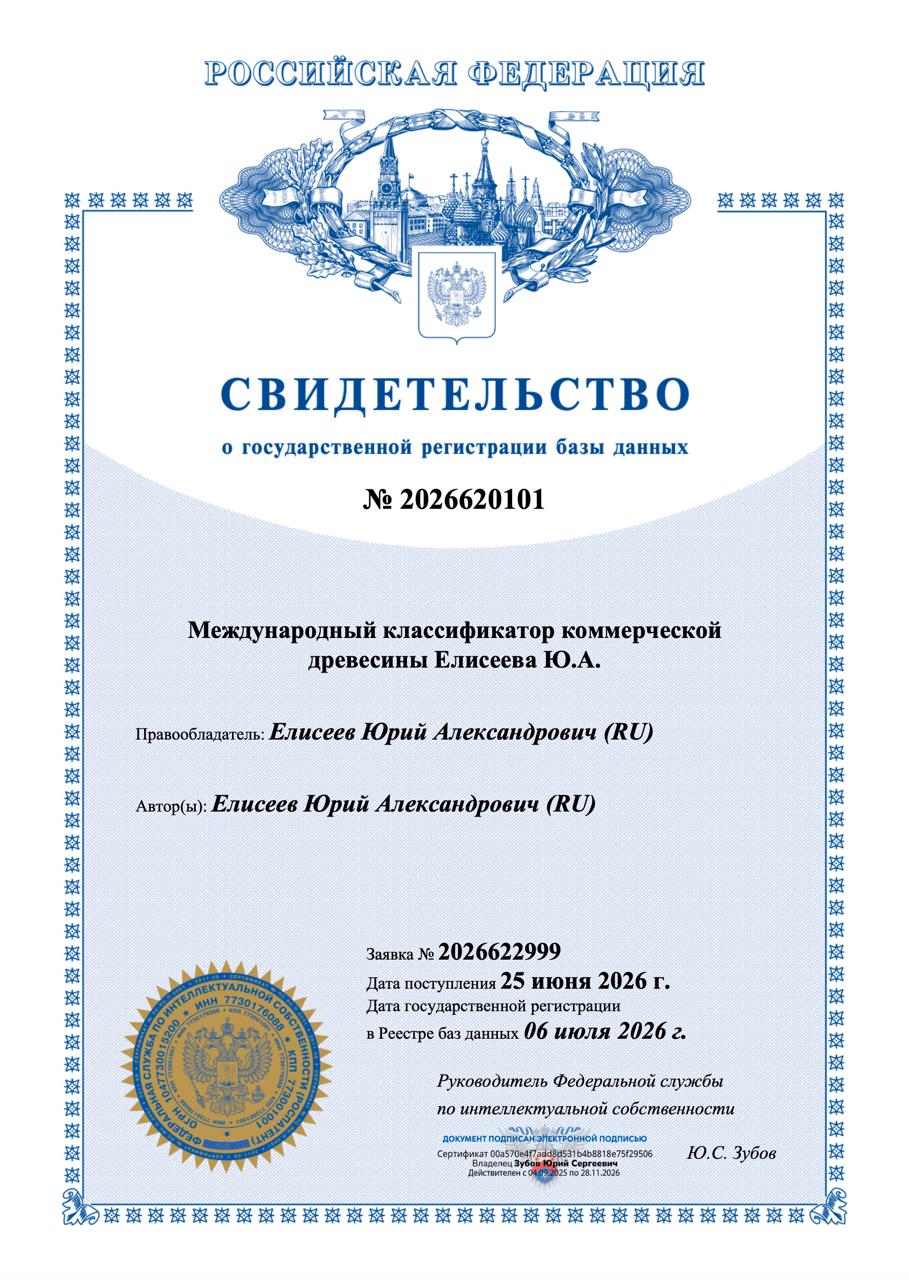
Certificate No. 2026620101 confirms the state registration of the database in the Register of Databases. Rights holder and author: Yuri A. Eliseev.
The database systematizes and standardizes information about timber species that matter in global trade. It establishes a unified description and coding system based on physical and mechanical properties, so a species can be searched, compared, classified and verified consistently rather than identified informally.
The system standardizes records by physical and mechanical parameters; supports search and filtering; compares and classifies entries; decodes unique species codes; and provides controlled data management.
Each cell combines species with a defined hardness and durability profile. A cell can contain from 1 to 25 timber species; the matrix is the basis for a unified code and reproducible verification.
World commercial timber (WCT) lacks a unified scientific classification: species get confused, standards are fragmented, and origin/species verification is hard.
I built a matrix system of WCT standards and a scientific taxonomy: each timber species is described by a feature matrix and classified/verified with Data Science — reproducibly and at scale.
Timber species features worldwide
WCT matrix standards system
Scientific classification by feature matrix
Species check and validation
A unified taxonomy of world timber species with matrix verification — a basis for industry standards, expertise and anti-substitution control.
Picture a shipment of premium timber: one trade name can hide different species, and telling them apart by eye is nearly impossible — hence mis-grading, disputes with suppliers and direct losses. UMZAR provides a unified scientific taxonomy and matrix verification: a species is identified by a set of features reproducibly and verifiably, not «on trust».
A unified scientific taxonomy — the end of species confusion and fragmented timber standards.
Matrix species verification — protection against species substitution and mis-grading.
Reproducible and scalable — a basis for industry standardization and expertise.
Send the context and desired outcome. I will identify the architecture, risks and the first useful milestone.